ADA Page- Info on Pools and the ADA Regulations
 |
Alden Pool & Municipal Supply Co. 1-800-253-7235 1-507-863-2367 (Fax) Over 35 years serving the industry Member of: AWWA, MRWA & ABPA Email me (just click) at johnszymanski99@hotmail.com A.F.T.G.O.G When you’re in need, we can hop to it. We specialize in assistance and our business is built on prompt service and fair prices. |

This site is designed to familiarize you with the ADA (American Diasabilities Act) guidelines and recommendations regarding swimming pools and spas.
Relevant Links:
- IRS Tax Credits and Deductions
- 2010 ADA STANDARDS FOR ACCESSIBLE DESIGN
- Revised ADA Regulations Implementing Title II and Title III (Taking effect on March 15, 2011, updated April 1, 2011)
- Revised ADA Requirements: Effective Date and Compliance Date (New February 16, 2011)
- ADA Primer for Small Business
- ADA Minnesota
- The ADA Checklist for Readily Achievable Barrier Removal
-
http://www.access-board.gov/recreation/guides/pools.htm
|
Information from an email sent to me upon request from Cindy Tarshish at the Minnesota ADA office on new regulations for pools:
2010 ADA Standards for Accessible Design
1. March 15, 2012 compliance date applies to new construction and
alteration undertaken on or after that date
2. March 15, 2012 clock begins ticking for state and local governments
to meet program access obligations under Title II regarding existing
facilities where pools are located
3. March 15, 2012 clock begins ticking for places of public
accommodations regarding obligations under Title III to engage in
barrier removal
4. 2010 standards require fixed lifts at each body of water
5. Portable lift is only and option after there has been a determination
that is not readily achievable to install a fixed lift.
6. Even if portable is option the obligation for barrier removal does
not go away (portable lift is not permanent solution) |
||
This site is designed to familiarize you with the ADA (American Diasabilities Act) guidelines and recommendations regarding swimming pools and spas.
Information on laws, rsources, products, and possible funding sources are covered.
|
From the government site:
www.access-board.gov/recreation/guides/pools.htm The Americans with
Disabilities Act (ADA) is a comprehensive civil rights law that
prohibits discrimination on the basis of disability. The ADA requires
that newly constructed and altered state and local government
facilities, places of public accommodation, and commercial facilities be
readily accessible to, and usable by, individuals with disabilities. The
ADA Accessibility Guidelines (ADAAG) is the standard applied to
buildings and facilities. Recreational facilities, including swimming
pools, wading pools, and spas, are among the facilities required to
comply with the ADA. This guide is intended to help designers and operators in using the accessibility guidelines for swimming pools, wading pools, and spas. These guidelines establish minimum accessibility requirements for newly designed or newly constructed and altered swimming pools, wading pools, and spas. This guide is not a collection of swimming pool or spa designs. Rather, it provides specifications for elements within a swimming pool or spa to create a general level of usability for individuals with disabilities. Emphasis is placed on ensuring that individuals with disabilities are generally able to access swimming pools and spas and use a variety of elements. Designers and operators are encouraged to exceed the guidelines where possible to provide increased accessibility and opportunities. Incorporating accessibility into the design of a swimming pool or spa should begin early in the planning process with careful consideration to the accessible routes and means of entry into the water. |
||
|
Types of Facilities and Required
Means of Entry into the Water
Swimming Pools The primary means of entry must be either a sloped entry into the
water or a pool lift that is capable of being independently operated by
a person with a disability. The secondary means of entry could be a pool
lift, sloped entry, transfer wall, transfer system, or pool stairs. It
is recommended that where two means of entry are provided, they be
different types and be situated on different pool walls. Pools with less than 300 linear feet of pool wall are only required
to provide one accessible means of entry, which must be either a pool
lift or sloped entry.
Aquatic Recreation Facilities
Catch Pools
Wading Pools
Spas Footrests are not required on pool lifts provided at spas. However,
footrests or retractable leg supports are encouraged, especially on
lifts used in larger spas, where the water depth is 34 inches or more
and there is sufficient space.
|

Who Must Comply?
The law requires that facilities classified as a Public Entity or a Public Accommodation must have access for disabled persons. Examples of these types of facilities are:
* Schools
* Athletic Clubs
* Municipalities
* Hotels/Motels
* Cities
* Water Parks
* Counties
* Swim Schools
* Any Place of Recreation
* Any Place of Education
* Any Place of Lodging
Facilities that are not open to the public or do not fall into one of the Public Entity or Public Accommodation categories (residential housing, condos, homeowner associations) are not required to comply, although it is highly recommended that they do.
|
Types of Accessible Means of Entry into the Water Pool lifts must be located where the water level is not deeper than
48 inches. This provides the opportunity for someone to provide
assistance from a standing position in the water if desired. If multiple
pool lift locations are provided, only one must be where the water is
less than 48 inches. If the entire pool is deeper than 48 inches, an
exception allows operators to use a pool lift in any location as an
accessible means of entry.
Seats Although not required, seats with backs will enable a larger number
of persons with disabilities to use the lift independently. Pool lift
seats made of materials that resist corrosion, that provide a firm base,
and that are padded are more usable. Headrests, seat belts, and
additional leg support may also enhance accessibility and accommodate a
wider variety of people with disabilities.
Clear Deck Space
Seat Height
Footrests and Armrests Armrests are not required, however if provided, the armrest opposite
the water must be removable or be able to fold clear of the seat when
the seat is in the raised (load) position. This clearance is needed for
people transferring between the lift and a mobility device.
Operation The controls and operating mechanisms must be unobstructed when a
lift is in use. A person must be able to use the lift with one hand, and
the operating controls must not require tight grasping, pinching, or
twisting of the wrist. Controls may not require more than five pounds of
pressure to operate.
Submerged Depth
Lifting Capacity |
Sloped Entries Sloped entries must comply with ADAAG accessible route provisions (36
inch minimum width, maximum 1:12 or 8.33% slope), except that the
surface does not need to be slip resistant. The slope may be designed as
zero grade beach or ramp access. With either design, the maximum slope
permitted is 1:12 (8.33%). In most cases, it is not appropriate to submerge personal wheelchairs
and mobility devices in water. Some have batteries, motors, and
electrical systems that can be damaged or contaminate the pool.
Facilities that use sloped entries are encouraged to provide an aquatic
wheelchair designed for access into the water. Persons transfer to the
aquatic wheelchair and access the water using it, leaving their personal
mobility device on the deck. Operators and facility managers may need to
consider storage options for personal mobility devices if deck space is
limited.
Submerged Depth
Handrails |
|
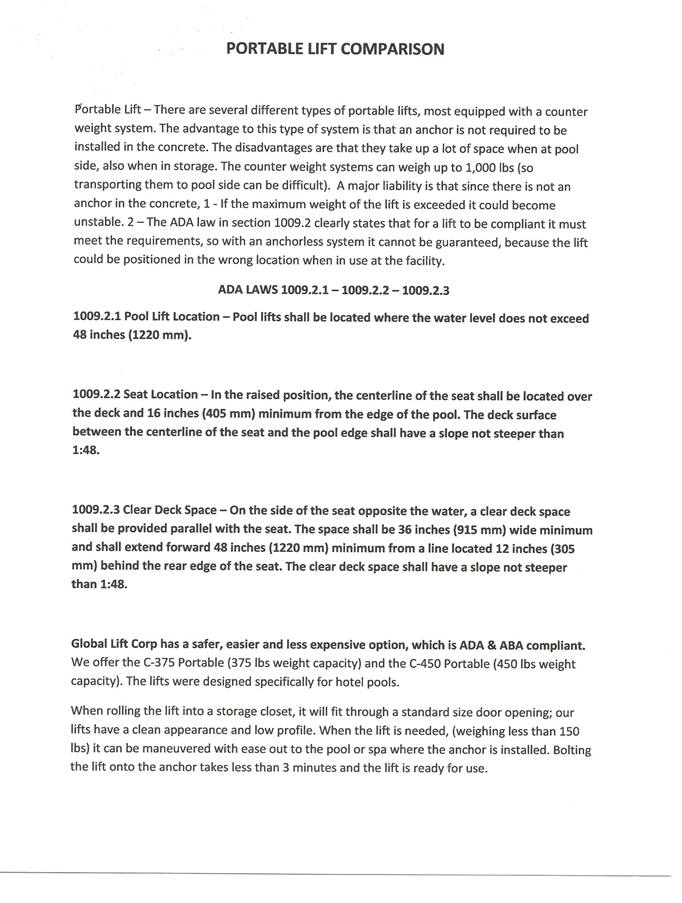
IMPORTANT Info on Portable Lifts
Due to the recent Department
of Justice clarifications on Title II & III entities there has been some
confusion on Portable Pool Lifts.
|
|
|
Accessible Pool Stairs Accessible pool stairs are designed to provide assistance with
balance and support from a standing position when moving from the pool
deck into the water and out. ADAAG provisions for stairs include the
requirement that all steps have uniform riser heights and uniform tread
widths of not less than 11 inches, measured from riser to riser.
Additionally, open risers are not permitted. Other stairs or steps
provided in the pool are not required to meet these guidelines.
Handrails
NOTE: If the existng stairs in your pool meet ALL of the below requirements, they may qualify as a second means of handicap access. (You may modify your existing steps, such as adding handrails to fulfill these requirements.)
Excerpts from
2010 ADA Standards for Accessible Design
504 Stairways
504.1 General.
Stairs shall comply with 504.
504.2 Treads and Risers.
All steps on a flight of stairs shall
have uniform riser heights and uniform tread depths. Risers shall be 4
inches (100 mm) high minimum and 7 inches (180 mm) high maximum. Treads
shall be 11 inches (280 mm) deep minimum.
504.3 Open Risers.
Open risers are not permitted.
504.4 Tread Surface.
Stair treads shall comply with 302.
Changes in level are not permitted.EXCEPTION: Treads shall be
permitted to have a slope not steeper than 1:48.
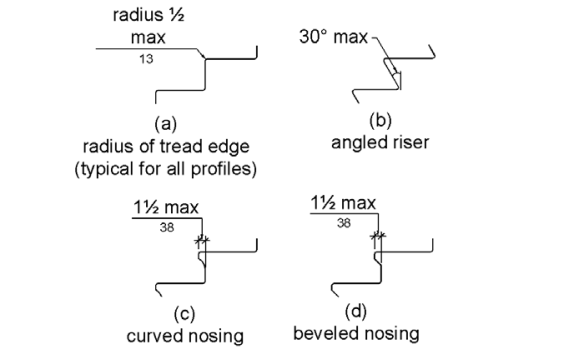
504.5 Nosings.
The radius of curvature at the leading
edge of the tread shall be ½ inch (13 mm) maximum. Nosings that project
beyond risers shall have the underside of the leading edge curved or
beveled. Risers shall be permitted to slope under the tread at an angle
of 30 degrees maximum from vertical. The permitted projection of the
nosing shall extend 1½ inches (38 mm) maximum over the tread below.
Figure 504.5
Stair NosingsTitles
Pg. 153 -
2010 Standards: Titles II and III
Department of Justice
--------------------------------------------------------------------------------------------------------------------------------------------
1009.6 Pool Stairs.
Pool stairs shall comply with 1009.6.
1009.6.1 Pool Stairs.
Pool stairs shall comply with 504.EXCEPTION:
Pool step riser heights shall not be required to be 4 inches (100
mm) high minimum and 7 inches (180 mm) high maximum provided that riser
heights are uniform.1009.6.2
Pg. 252 -
2010 Standards: Titles II and III
Department of Justice
|
Water Play Components If water play components are provided, they must comply with the
Access Board’s Play Area Guidelines and accessible route provisions. If the surface of the accessible route, clear floor or ground spaces,
and turning spaces that connect play components are submerged, the
accessible route does not have to comply with the requirements for cross
slope, running slope, and surface conditions. Transfer systems may be
used instead of ramps to connect elevated water play components. |

Tax IncentivesTwo tax incentives are available to businesses to help cover the cost of making access improvements. The first is a Disabled Access Credit that can be used for architectural adaptations, equipment acquisitions, and services such as sign language interpreters. The second is a tax deduction that can be used for architectural and transportation changes.Disabled Access Credit Small businesses with 30 or fewer employees or total revenues of $1 million or less can use the Disabled Access Credit (Internal Revenue Code, Section 44). Eligible small businesses may take a credit of up to $5,000 (half of eligible expenses up to $10,250, with no credit for the first $250) to offset their costs for access, including barrier removal from their facilities (e.g., widening a doorway, installing a ramp), provision of accessibility services (e.g., sign language interpreters), provision of printed material in alternate formats (e.g., large-print, audio, Braille), and provision or modification of equipment. Tax Deduction The tax deduction allows a business of any size to expense up to a maximum of $15,000 per year of items that normally must be capitalized (depreciated). This deduction may be used for expenses associated with the removal of architectural or transportation barriers in association with a trade or business that complies with applicable accessibility standards. Small businesses can use these incentives in combination if the expenditures incurred qualify under both the tax credit and tax deduction. This information has been compiled only for your convenience, and is not intended to take the place of professional consultation or official documentation. Please speak with an Accountant or qualified tax preparer for complete details about these programs.
CALL US - John at 800-253-7235
|
|
|